

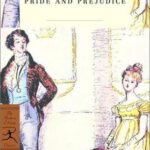
Pride and Prejudice
$9.00
| Title | Range | Discount |
|---|---|---|
| Trade Discount | 5 + | 25% |
- Description
- Additional information
Description
Introduction by Anna Quindlen Commentary by Margaret Oliphant, George Saintsbury, Mark Twain, A. C. Bradley, Walter A. Raleigh, and Virginia Woolf
Nominated as one of America’s best-loved novels by PBS’s The Great American Read “It is a truth universally acknowledged, that a single man in possession of a good fortune must be in want of a wife.” So begins Pride and Prejudice, Jane Austen’s witty comedy of manners—one of the most popular novels of all time—that features splendidly civilized sparring between the proud Mr. Darcy and the prejudiced Elizabeth Bennet as they play out their spirited courtship in a series of eighteenth-century drawing-room intrigues. Renowned literary critic and historian George Saintsbury in 1894 declared it the “most perfect, the most characteristic, the most eminently quintessential of its author’s works,” and Eudora Welty in the twentieth century described it as “irresistible and as nearly flawless as any fiction could be.”
Includes a Modern Library Reading Group Guide "The wit of Jane Austen has for partner the perfection of her taste."
–Virginia Woolf Anna Quindlen is a Pulitzer Prize–winning journalist and novelist whose work has appeared on fiction, nonfiction, and self-help bestseller lists. Her work includes the essay collection Lots of Candles, Plenty of Cake, the inspirational book A Short Guide to a Happy Life, and six novels: Object Lessons, One True Thing, Black and Blue, Blessings, Rise and Shine, and Every Last One.
1. Pride and Prejudice was originally titled First Impressions. Critic Brian Southam notes that this phrase comes from the language of the sentimental novels Austen often criticized, where it connoted the idea that one ought to trust one’s immediate, intuitive response to things. It is widely believed that Austen derived the later title from the fifth book of Cecilia, a novel by Fanny Burney, where the phrase appears (according to Austen biographer Park Honan, however, the phrase dates earlier, to a 1647 book by Jeremy Taylor called Liberty of Prophesying, and also appears in Gibbon’s 1776 Decline and Fall of the Roman Empire). Anna Quindlen, in her Introduction to the Modern Library edition, indicates her preference for the second title ("Austen originally named the book First Impressions; thank God for second thoughts!"). Which do you think is the more appropriate title and why?
2. The famous opening line of Pride and Prejudice-"It is a truth universally acknowledged, that a single man in possession of a good fortune must be in want of a wife "-magnificently displays the irony that suffuses the novel at both local and structural levels. What is the purpose of irony in Pride and Prejudice!?
3. Austen was writing during a time when novels in the form of letters – called epistolary novels-were very popular. There are nearly two dozen letters quoted in whole or in part in Pride and Prejudice, and numerous other references to letters and letter – writing. How do you think letters function in the novel? How do the letters – a narrative element-interact with the dramatic element (manifested in the dialogue)?
4. A number of critics have maintained that Darcy is not a particularly well – developed or believable character, and that his transformation is a mere plot contrivance. Others have argued that this suggestion fails to take into account the fact that the reader in large part only sees Darcy through the prejudiced eyes of Elizabeth. Which side would you take in this debate, and why?
5. Pride and Prejudice has often been criticized for the fact that it appears unconcerned with the politics of Austen’s day. For example, in a letter (written before World War 1) to Thomas Hardy, Frederic Harrison refers to Austen as a "heartless little cynic" who composed "satirettes against her neighbors whilst the Dynasts were tearing the world to pieces and consigning millions to their graves." Is this charge fair?
6. Charlotte Bronte wrote in an 1848 letter to G. H. Lewes: Why do you like Miss Austen so very much? I am puzzled on that point. What induced you to say that you would have rather written Pride and Prejudice, or Tom Jones, than any of the Waverley Novels? I had not seen Pride and Prejudice till I read that sentence of yours, and then I got the book. And what did I find? An accurate, daguerreotyped portrait of a commonplace face; a carefully – fenced, highly – cultivated garden, with neat borders and delicate flowers; but no glance of a bright, vivid physiognomy, no open country, no fresh air, no blue hill, no bonny beck. I should hardly like to live with her ladies and gentlemen, in their elegant but confined houses. Do you agree with Bronte’s claim that there is no poetry or passion in Pride and Prejudice, and her conclusion that "Miss Austen being … without sentiment, without poetry, maybe is sensible, real (more real than true), but she cannot be great"?
CHAPTER 1
IT IS A TRUTH universally acknowledged that a single man in
possession of a good fortune must be in want of a wife.
However little known the feelings or views of such a man may be on
his first entering a neighbourhood, this truth is so well fixed in
the minds of the surrounding families that he is considered as the
rightful property of some one or other of their daughters.
"My dear Mr. Bennet," said his lady to him one day, "have you heard
that Netherfield Park is let at last?"
Mr. Bennet replied that he had not.
"But it is," returned she; "for Mrs. Long has just been here, and she
told me all about it."
Mr. Bennet made no answer.
"Do not you want to know who has taken it?" cried his wife impatiently.
"You want to tell me, and I have no objection to hearing it."
This was invitation enough.
"Why, my dear, you must know, Mrs. Long says that Netherfield is
taken by a young man of large fortune from the north of England; that
he came down on Monday in a chaise and four to see the place, and was
so much delighted with it that he agreed with Mr. Morris immediately;
that he is to take possession before Michaelmas, and some of his
servants are to be in the house by the end of next week."
"What is his name?"
"Bingley."
"Is he married or single?"
"Oh! single, my dear, to be sure! A single man of large fortune; four
or five thousand a year. What a fine thing for our girls!"
"How so? How can it affect them?"
"My dear Mr. Bennet," replied his wife, "how can you be so tiresome!
You must know that I am thinking of his marrying one of them."
"Is that his design in settling here?"
"Design! nonsense, how can you talk so! But it is very likely that he
may fall in love with one of them, and therefore you must visit him
as soon as he comes."
"I see no occasion for that. You and the girls may go, or you may
send them by themselves, which perhaps will be still better, for as
you are as handsome as any of them, Mr. Bingley might like you the
best of the party."
"My dear, you flatter me. I certainly have had my share of beauty,
but I do not pretend to be anything extraordinary now. When a woman
has five grown-up daughters, she ought to give over thinking of her
own beauty."
"In such cases, a woman has not often much beauty to think of."
"But, my dear, you must indeed go and see Mr. Bingley when he comes
into the neighbourhood."
"It is more than I engage for, I assure you."
"But consider your daughters. Only think what an establishment it
would be for one of them. Sir William and Lady Lucas are determined
to go, merely on that account, for in general you know they visit no
newcomers. Indeed you must go, for it will be impossible for us to
visit him if you do not."
"You are over scrupulous surely. I dare say Mr. Bingley will be very
glad to see you; and I will send a few lines by you to assure him of
my hearty consent to his marrying whichever he chooses of the girls;
though I must throw in a good word for my little Lizzy."
"I desire you will do no such thing. Lizzy is not a bit better than
the others; and I am sure she is not half so handsome as Jane, nor
half so good-humoured as Lydia. But you are always giving her the
preference."
"They have none of them much to recommend them," replied he; "they
are all silly and ignorant like other girls; but Lizzy has something
more of quickness than her sisters."
"Mr. Bennet, how can you abuse your own children in such a way? You
take delight in vexing me. You have no compassion on my poor nerves."
"You mistake me, my dear. I have a high respect for your nerves. They
are my old friends. I have heard you mention them with consideration
these twenty years at least."
"Ah! you do not know what I suffer."
"But I hope you will get over it, and live to see many young men of
four thousand a year come into the neighbourhood."
"It will be no use to us if twenty such should come since you will
not visit them."
"Depend upon it, my dear, that when there are twenty, I will visit them all."
Mr. Bennet was so odd a mixture of quick parts, sarcastic humour,
reserve, and caprice, that the experience of three and twenty years
had been insufficient to make his wife understand his character. Her
mind was less difficult to develop. She was a woman of mean
understanding, little information, and uncertain temper. When she was
discontented she fancied herself nervous. The business of her life
was to get her daughters married; its solace was visiting and news. US
Additional information
| Weight | 8.2 oz |
|---|---|
| Dimensions | 0.6500 × 5.2000 × 8.0000 in |
| ISBN-13 | |
| Imprint | |
| Format | |
| Author | |
| Audience | |
| BISAC | |
| Subjects | jane austen books, classic literature, classic books, satire, great american read, popular books, mom gifts, jane austen gifts, pride and prejudice book, penguin classics, sister gifts, jane austen pride and prejudice, pride and prejudice jane austen, british fiction, gift for grandma, classic book, pride prejudice book, historical fiction, classic, romance, love, classics, FIC019000, gifts for mom, Sisters, classic novels, marriage, Jane Austen, enemies to lovers, historical romance, FIC027170, Emma, Sense and Sensibility, Pride and Prejudice |