


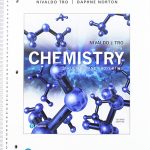
Laboratory Manual for Chemistry
$113.32
| Title | Range | Discount |
|---|---|---|
| Trade Discount | 5 + | 25% |
- Description
- Additional information
Description
About the Book
Build 21st Century Skills with new end-of-chapter problems.
- Data Interpretation and Analysis Problems help students build skills in analyzing and interpreting data. Today’s students can access huge amounts of data all the time, but can they understand, interpret, and draw meaningful conclusions from it? A new category of questions called Data Interpretation and Analysis questions use real data from real life situations to ask students to analyze, interpret and interact with data, providing practice in reading graphs, digesting tables, and making data-driven decisions. These are also assignable in Mastering Chemistry.
- Questions for Group Work encourage the development of communication and group problem-solving skills. These questions give students the opportunity to work with their peers in small groups in or out of the classroom. Detailed, multi-concept questions foster collaborative learning and give students the opportunity to work together as a team to solve problems. Questions for Group Work are also assignable within Learning Catalytics.
- Twice as many Mastering™ Chemistry end-of-chapter questions with wrong answer specific feedback appear in each chapter of this edition compared to the previous, giving students more opportunities to exercise critical thinking and achieve learning gains while practicing problem solving.
Feature Updates
- New Chapter E Measurement and Problem Solving, covers units, measurement, and problem solving (E for essentials). This material, formerly located in Appendices I and II in the first edition, was revised and moved to the front of of the book to help provide a foundation for students who need some review in these areas. For instructors who feel their students do not need more review, the chapter can easily be skipped.
- Additional Conceptual Connection questions have been added throughout the book, allowing students to quickly check their comprehension of the important topics as they complete chapter sections.
- All the data in the book has been updated to reflect the most recent measurements available. These updates include Figure 7.2 Carbon Dioxide in the Atmosphere; Figure 7.3 Global Temperatures; and Figure 14.19 Ozone Depletion in the Antarctic Spring.
- The art program has been revised throughout to move key points out of the caption and into the art itself. Dozens of figures have new annotations and labels to help readers better scan and retain key points from the art program. New labels position relevant information closest to its point of relevance, rather than relegating it to the caption. Related labels and annotations within an image are treated in the same way, making important connections immediately evident. The updated art teaches and presents complex information clearly and concisely ensuring that the art program is a useful and accessible teaching and study aide for students who focus on images.
- Chapter 1 (Atoms) has been revised to include a more personal introduction that documents the author’s own introduction into the world of atoms. The mole concept for atoms, previously in Chapter 2, has also been moved into Chapter 1 so the reader is exposed to this key information earlier.
- Phase diagrams have been moved into Chapter 11 Liquids, Solids, Intermolecular Forces, and Phase Diagrams to immediately follow the coverage of liquids, solids, and intermolecular forces and reinforce those concepts.
- In addition to presenting the chemistry of modern materials, Chapter 12 Crystalline Solids and Modern Materials includes new topics and consolidates content on materials previously found in other parts of the book.
Content changes. many made in response to reviewer feedback, include the following:
- Sections E.1, 1.1, 9.1, 11.1, 12.1, and 18.1
- Chapter-opening sections and corresponding art revised to better engage readers.
- Section 7.5:
- New subsection (Reactant in Excess)
- New worked example: Example 7.8 Reactant in Excess
- Section 8.7:
- New content on acid-base reactions involving a weak acid
- New worked example: Example 8.12 Writing Equations for Acid—Base Reactions involving a Weak Acid
- Section 8.9:
- New content on the activity series for metals
- New worked example: Example 8.18 Predicting Spontaneous Redox Reactions
- Chapter 10 Gases
- Reorganized; kinetic molecular theory covered earlier in order to emphasize the particulate nature of gases
- Section 12.3
- New worked example: Example 12.2 Calculating the Packing Efficiency of a Unit Cell
- Chapter 18 Free Energy and Thermodynamics
- New section: Section 18.4 Entropy Changes Associated with State Changes with new subsection covering calculation of entropy changes associated with state changes
- New worked example: Example 18.2 Calculating S for a State Change
- New content on reversible and irreversible processes
- Chapter 20 Radioactivity and Nuclear Chemistry
- Sections 20.3 and 20.5 and Tables 20.1 and 20.4 modified and updated
Also available with Mastering Chemistry
Mastering™ Chemistry is the leading online homework, tutorial, and assessment system, designed to improve results by engaging students with powerful content. The enhanced eText 2.0 and Mastering Chemistry work with the book to provide seamless and tightly integrated videos and other rich media and assessment throughout the course. Instructors can assign interactive media before class to engage students and ensure they arrive ready to learn. Students further master concepts through book-specific Mastering Chemistry assignments, which provide hints and answer-specific feedback that build problem-solving skills. With Learning Catalytics™ instructors can expand on key concepts and encourage student engagement during lecture through questions answered individually or in pairs and groups. Mastering Chemistry now provides students with the new General Chemistry Primer for remediation of chemistry math skills needed in the general chemistry course.
- Develop Students’ 21st Century Skills with new Mastering Chemistry problems.
- Data Interpretation and Analysis Problems help students build skills in analyzing and interpreting data. Today’s students have access to huge amounts of data all the time, but can they understand, interpret, and draw meaningful conclusions from it? Assignable in Mastering Chemistry, this new category of questions called Data Interpretation and Analysis questions uses real data from real life situations to ask students to analyze, interpret and interact with data, providing practice in reading graphs, digesting tables, and making data-driven decisions.
- Questions for Group Work encourage the development of communication and group problem-solving skills. These questions give students the opportunity to work with their peers in small groups in or out of the classroom. Detailed, multi-concept questions foster collaborative learning and give students the opportunity to work together as a team to solve problems. Questions for Group Work are also assignable within Learning Catalytics.
- Twice as many Mastering Chemistry end-of-chapter questions with wrong answer specific feedback appear in each chapter of this edition compared to the previous, giving students more opportunities to exercise critical thinking and achieve learning gains while practicing problem solving.
- Seamlessly integrated videos and rich media embedded in the new eText 2.0 help students connect concepts.
- Conceptual Connections and Self-Assessment Quizzes now Interactive! Students can now interact with all conceptual connection and self-assessment quizzes within eText 2.0! With one click on the eText 2.0 icon, these activities are brought to life, allowing students to study on their own and test their understanding in real-time. Complete with answer-specific feedback, these interactives help students extinguish misconceptions and deepen their understanding of important topics.
- Key Concept Videos combine artwork from the textbook with 2D and 3D animations to create a dynamic on-screen viewing and learning experience. These short videos include narration and brief live-action clips of author Nivaldo Tro explaining the key concept of each chapter of Chemistry: Structure and Properties. Students interact when the video stops and poses a question that they must answer before continuing. Each video also includes a follow-up question that is assignable in Mastering Chemistry.
- Interactive Worked Examples are digital versions of select worked examples from the text that make Tro’s unique problem-solving strategies interactive. These digital versions instruct students how to break down problems using Tro’s “Sort, Strategize, Solve, and Check” technique. Like the Key Concept Videos, Interactive Worked Examples stop in the middle and force the student to interact by completing a step in the example. The examples also have a follow-up question that is assignable in Mastering Chemistry.
- The Chemistry Primer helps students remediate their chemistry math skills and prepare for their first college chemistry course.
- Pre-built Assignments get students up to speed at the beginning of the course.
- Math is covered in the context of chemistry, basic chemical literacy, balancing chemical equations, mole theory, and stoichiometry.
- Scaled to students’ needs, remediation is only suggested to students that perform poorly on an initial problem.
- Remediation includes tutorials, wrong-answer specific feedback, video instruction, and step-wise scaffolding to build students’ abilities.
- eText 2.0, optimized for mobile seamlessly integrates videos and other rich media with the text and gives students access to their textbook anytime, anywhere.
- eText 2.0 mobile app offers offline access and can be downloaded for most iOS and Android phones/tablets from the Apple App Store or Google Play
- Accessible (screen-reader ready)
- Configurable reading settings, including resizable type and night reading mode
- Instructor and student note-taking, highlighting, bookmarking, and search
- NEW! 66 Dynamic Study Modules help students study effectively on their own by continuously assessing their activity and performance in real time.
- Students complete a set of questions with a unique answer format that also asks them to indicate their confidence level. Questions repeat until the student can answer them all correctly and confidently. These are available as graded assignments prior to class and are accessible on smartphones, tablets, and computers.
- Topics include key math skills such as significant figures and scientific notation, as well as general chemistry concepts such as understanding matter, chemical reactions, and understanding the periodic table & atomic structure. Topics can be added or removed to match your coverage.
- Learning Catalytics™ helps instructors generate class discussion, customize lectures, and promote peer-to-peer learning with real-time analytics.This student response tool uses students’ smartphones, tablets, or laptops to engage them in more interactive tasks and thinking.
- NEW! Upload a full PowerPoint® deck for easy creation of slide questions.
- NEW! Team names are no longer case sensitive.
- Helps students develop critical thinking skills.
- Allows instructors to monitor responses to find out where students are struggling.
- Instructors can rely on real-time data to adjust teaching strategy.
- Automatically group students for discussion, teamwork, and peer-to-peer learning.
- Simulations cover difficult chemistry concepts. Written by leading authors in simulation development, they foster student understanding of chemistry and clearly illustrate cause-and-effect relationships in topics such as electrolysis, kinetic molecular theory, stoichiometry, and calorimetry. Each interactive includes opportunity for assessment.
- Ready-to-Go Teaching Modules created for and by instructors provide a guide for easy-to-use assignments for before and after class plus in-class activities with clicker questions and questions in Learning Catalytics™. Modules can be easily accessed via Mastering Chemistry.
About our author
Nivaldo Tro has been teaching college Chemistry since 1990 and is currently teaching at Santa Barbara Community College. He received his Ph.D. in chemistry from Stanford University for work on developing and using optical techniques to study the adsorption and desorption of molecules to and from surfaces in ultrahigh vacuum. He then went on to the University of California at Berkeley, where he did postdoctoral research on ultrafast reaction dynamics in solution. Professor Tro has been awarded grants from the American Chemical Society Petroleum Research Fund, the Research Corporation, and the National Science Foundation to study the dynamics of various processes occurring in thin adlayer films adsorbed on dielectric surfaces. Professor Tro lives in Santa Barbara with his wife, Ann, and their four children, Michael, Ali, Kyle, and Kaden. In his leisure time, Professor Tro enjoys mountain biking, surfing, and being outdoors with his family.
- Liquid Crystals
- Atomic Emission Spectra: Comparing Experimental Results to Bohr’s Theoretical Model
- Energy & Electromagnetism: Irradiance Measurements
- Structure of Molecules
- A Gravimetric Analysis of Phosphorus in Fertilizer
- Recycling Aluminum
- Qualitative Analysis: The Detection of Anions
- Qualitative Analysis: Detection of Metal Cations
- Qualitative Analysis: Identification of a Single Salt
- Qualitative Analysis of Household Chemicals
- Iron Deficiency Analysis
- Gasimetric Analysis of a Carbonate
- Calorimetry: Heat of Fusion and Specific Heat
- Chromatography: Isolation and Characterization of Yellow Dye No. 5
- Freezing Point: Depression or A Lesson in Making Ice Cream
- Alternative Fuel Project
- The Green Fades Away
- Chemical Kinetics
- Analysis of Phosphoric Acid in Coca-Cola Classic: Spectrophotometric Method
- Analysis of Phosphoric Acid in Coca-Cola Classic: pH Titration
- Borax Solubility: Investigating the Relationship between Thermodynamics and Equilibrium
- Electrochemical Preparation of Nickel Nanowires
- Synthesis of K3Fe(C2O4)3 • 3H2O
- Analysis of Oxalate in K3Fe(C2O4)3 • 3H2O
Hallmark features of this title
- Objectives are clearly outlined, and steps are in place where the student must discuss methods with the instructor before proceeding with the experiment.
- Pre-lab questions guide students through the reasoning process necessary to solve the problem presented and provide the necessary background for the experiments.
- Post-lab questions connect students to environmental problems for experiments such as calorimetry, energy, and freezing point depression.
- Samples of problem-based and traditional experiments offer flexibility to the instructors.
- Diagrams for techniques such as pipetting and vacuum filtration are placed in the text of the experiment. The information is available as it becomes necessary for a procedure.
Laboratory Manual for Chemistry: Structure and Properties, 2nd Edition is authored by Daphne Norton from the University of Georgia. Written to correspond with teaching using an atoms-first approach, this author emphasizes critical thinking and problem-solving skills while fostering student engagement in real world applications. Students will be exposed to recent advances in science by presenting labs in an investigative context. Emphasis is placed on data collection and analysis versus mere step-by-step instruction.
For laboratory courses in General Chemistry
Engaging students in real-world applications
Laboratory Manual for Chemistry: Structure and Properties provides a series of experiments written to correspond with an atoms-first approach.
The experiments connect to the daily lives of students with engaging experiments that have real-world applications and incorporate household items such as Coca-Cola®, fertiliser, light bulbs, and aluminum cans. The investigations challenge students while exposing them to recent advances in science.
The labs also promote critical thinking by placing the experiments in the context of a practical problem and emphasise data collection and analysis versus mere step-by-step instruction. Some of the exercises are inquiry-driven, while others provide a straightforward method for introducing new laboratory techniques. This manual includes a sample of problem-based and traditional experiments to give instructors flexibility.
Additional information
| Dimensions | 0.40 × 8.70 × 10.70 in |
|---|---|
| Imprint | |
| Format | |
| ISBN-13 | |
| ISBN-10 | |
| Author | |
| Subjects | science, chemistry, higher education, general chemistry, Physical Sciences |