


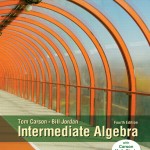
Intermediate Algebra
$266.65
| Title | Range | Discount |
|---|---|---|
| Trade Discount | 5 + | 25% |
- Description
- Additional information
Description
New in MyMathLab
- Two MyMathLab course options are now available:
- Standard MyMathLab courses allow instructors to build their course their way, offering maximum flexibility and control over all aspects of assignment creation.
- Ready to Go courses provide students with all the same great MyMathLab features, but also make it easier for instructors to get started. Both Carson course options include one premade pre-test and post-test for every chapter, section-level homework, and a chapter review quiz linked to personalized homework. Assignments are also pre-assigned in the Ready to Go courses.
- MyWorkBook is an objective-based workbook (available in print and in MyMathLab) that includes the following resources for each section of the text:
- Key vocabulary terms and practice problems
- Guided Examples with stepped-out solutions and similar Practice Exercises, keyed to the text by Learning Objective
- Referencesto textbook Examples and Section Lecture Videos for additional help
- Additional Exercises with ample space for students to show their work, keyed to the text by Learning Objective
New and Revised in the Text
- Learning Strategy boxes written by successful students and recent college graduates offer advice on implementing the study system effectively based on a students’ learning style.
- The Chapter Openers now provide a brief topical overview of the chapter. In the instructor’s edition, each opener now includes teaching suggestions for the chapter.
- New in the Exercises
- Warm-up Exercises (which now begin each section) review previously learned material helpful to understanding the concepts in the section.
- Prep Exercises help students focus on the terminology, rules, and processes corresponding to the exercises that immediately follow.
- Section Exercises are now grouped by objective, to make it easier for students to connect examples with related exercises. They are also carefully graded to allow students to build confidence in their problem-solving skills as they work through the homework.
- The Chapter Summary and Review is now interactive, with Review Exercises integrated within the Summary to encourage active learning and review.
Content Updates
- Chapter 1: The real numbers diagram in Section 1.1 has been revised to match the treatment in the revised diagram for complex numbers, which appears in Section 8.7.
- Chapter 2: Application problems involving two unknowns have been eliminated from this chapter. In the authors’ experience, students find it easier and more intuitive to solve those problems using systems of equations; so the topic is now covered with systems.
- Chapter 3: Absolute value functions have been added to Section 3.5.
- Chapter 4 Problems involving two unknowns are now introduced in this chapter rather than in an earlier chapter using single-variable equations as in previous editions. Solving these problems using systems of equations is more intuitive to students. Cramer’s Rule has been moved to Appendix O.
- Chapter 5: The exposition in Section 5.2 has been streamlined.
- Chapter 6: In Section 6.4, the order of Objectives 2 and 3 have been switched from the previous edition so that finding intercepts of quadratic and cubic functions precedes solving problems involving quadratic equations.
- Chapter 7: The discussion of LCD and the examples of variation were streamlined and are now covered in a more visual presentation.
- Chapter 8: The development of complex numbers is now more precise.
Tom Carson ’s first teaching experience was teaching guitar while an undergraduate student studying electrical engineering. That experience helped him to realize that his true gift and passion are for teaching. He earned his MAT in mathematics at the University of South Carolina. In addition to teaching at Midlands Technical College, Columbia State Community College, and Franklin Classical School, Tom has served on the faculty council and has been a board member of the South Carolina Association of Developmental Educators (SCADE). Ever the teacher, Tom teaches outside the classroom by presenting at conferences such as NADE, AMATYC, and ICTCM on topics such as Combating Innumeracy, Writing in Mathematics, and Implementing a Study System. In addition to his work on the Carson Developmental Algebra Series, Tom also is the author of Prealgebra, Fourth Edition.
Bill Jordan received his BS from Rollins College and his MAT from Tulane University. A decorated teacher for more than 40 years, Bill has served as the chair of the math department at Seminole Community College and has taught at Rollins College. He has been a member and leader of numerous professional organizations, including the Florida Two-Year College Mathematical Association (president), Florida Council of Teachers of Mathematics (district director), and others. In addition to his work on the Carson series, Bill is also the lead author of Integrated Algebra and Arithmetic, 2/e, also published by Pearson. In his spare time, he enjoys fishing, traveling, and hiking.
What’s Your Style?
The Carson Algebra Series guides students to success by presenting the why behind understanding algebra, and includes the complete Carson Math Study System with a Learning Styles Inventory to address individual learning styles. The Carson Math Study System adapts to the way each student learns, and targeted learning strategies are presented throughout the program. The authors speak to students in everyday language and walk them through the concepts, explaining not only how to do the math, but also where the concepts come from and why they work to foster conceptual understanding.
Teaching and Learning Experience
This program will provide a better teaching and learning experience for you and your students. Here’s how:
- Improve Results: MyMathLab delivers proven results in helping students succeed and provides engaging experiences with personalized learning. The new edition supports students with MyWorkBook and MyMathLab course revisions that bring it all together!
- Support all learning styles and promote good study skills: the completeCarson Math Study System with Learning Styles Inventory guides students to success in the course.
- Rely on a proven pedagogy that explains the why behind algebra: in everyday language the program walks students through the concepts, explaining not only how to do the math, but also where the concepts come from and why they work.
Note: You are purchasing a standalone product; MyMathLab does not come packaged with this content. MyMathLab is not a self-paced technology and should only be purchased when required by an instructor. If you would like to purchase both the physical text and MyMathLab, search for:
0321951891 / 9780321951892 Intermediate Algebra, Plus NEW MyMathLab with Pearson eText — Access Card Package
Package consists of:
0321431308 / 9780321431301 MyMathLab — Glue-in Access Card
0321654064 / 9780321654069 MyMathLab Inside Star Sticker
0321915879 / 9780321915870 Intermediate Algebra
Improve Results: MyMathLab delivers proven results in helping students succeed and provides engaging experiences with personalized learning. The new edition supports students with MyWorkBook and MyMathLab course revisions that bring it all together!
- NEW! Two MyMathLab course options are now available:
- Standard MyMathLab courses allow instructors to build their course their way, offering maximum flexibility and control over all aspects of assignment creation.
- Ready to Go courses provide students with all the same great MyMathLab features, but also make it easier for instructors to get started. Both Carson course options include one premade pre-test and post-test for every chapter, section-level homework, and a chapter review quiz linked to personalized homework. Assignments are also pre-assigned in the Ready to Go courses.
- Additional MyMathLab features include:
- The Learning Styles Inventory is an interactive version of the questionnaire in the textbook, allowing students to assess their learning styles to take full advantage of the book’s learning features.
- Increased exercise coverage gives students more practice exercises than ever before.
- Section Lecture Videos are available for every section. They offer a new navigation menu by objective, can be played on mobile devices, and include closed captioning.
- Chapter Test Prep Videos contain step-by-step video solutions to every exercise in the end of chapter Practice Tests. An instructor walks students through each problem, allowing students to pause and rewind as needed so they can study at their own pace. Chapter Test Prep Videos are available in MyMathLab, and on YouTube™ (search using author name and book title). Videos include closed captioning.
- NEW! MyWorkBook is an objective-based workbook (available in print and in MyMathLab) that includes the following resources for each section of the text:
- Key vocabulary terms and practice problems
- Guided Examples with stepped-out solutions and similar Practice Exercises, keyed to the text by Learning Objective
- Referencesto textbook Examples and Section Lecture Videos for additional help
- Additional Exercises with ample space for students to show their work, keyed to the text by Learning Objective
- Student Success Module in MyMathLab: This new, interactive module is available in the left-hand navigation of MyMathLab and includes videos, activities, and post-tests for these three student success areas:
- Math-Reading Connections, including topics such as Using Word Clues, and Looking for Patterns.
- Study Skills, including topics such as Time Management and Preparing for and Taking Exams.
- College Success, including topics such as College Transition and Online Learning.
- Instructors can assign these videos and/or activities as media assignments, along with pre-built post-tests to make sure students learn and understand how to improve their skills in these areas. Instructors can integrate these assignments with their traditional MyMathLab homework assignments to incorporate student success topics into their course as they deem appropriate.
- Accessibility Enhancements continue Pearson’s commitment to make products accessible to as many students as possible. This latest course release is compatible with the JAWS screen reader enabling print-disabled students to access and interact with numerous problems as noted by an icon within the assignment manager. The course also works with the ZoomText enlarger, and includes an HTML eBook that is compatible with JAWS and other Windows screen readers allowing all students to access the same text, at the same place, and at the same price. Additionally all videos include closed captioning.
Support all learning styles and promote good study skills–the completeCarson Math Study System is designed to help students develop the skills (e.g. time management, test-prep, note-taking) that students need to succeed in math, their careers, and life.
- The Carson Math Study System is presented at the start of the textbook and MyMathLab Course, and includes:
- A To the Student section that focuses on why math is important and what students need to do to succeed in their math courses.
- A Learning Styles Inventory in the textbook or in MyMathLab that will help students assess their particular style of learning, and use that knowledge to identify study skills that will help them. Once students determine their Learning Style, Learning Strategy boxes, at point-of-use throughout the text, offer tactile, visual, and auditory learners study strategies targeted to their style.
- The Math Study System, that offers students abundant suggestions for developing a class notebook to reflect their personal learning styles, taking effective notes, doing homework, and reviewing for quizzes and tests.
- NEW! Learning Strategy boxes written by successful students and recent college graduates offer advice on implementing the study system effectively based on a students’ learning style.
Rely on a proven pedagogy that explains the why behind algebra–in everyday language the program walks students through the concepts, explaining not only how to do the math, but also where the concepts come from and why they work.
- Carefully developed learning aids give landmarks and guidance at key stages in the chapter, helping students understand the material and see how it all fits together.
- The Algebra Pyramid is used as an underlying theme throughout the text to illustrate how each topic relates to the big picture of algebra.
- NEW! The Chapter Openers now provide a brief topical overview of the chapter. In the instructor’s edition, each opener now includes teaching suggestions for the chapter.
- Connection boxes are designed to bridge the concepts presented throughout the text so students understand how they build on each other.
- Real, Relevant, and Interesting Applications in the examples and exercises illustrate the everyday use of basic algebraic concepts by reflecting real situations in science, engineering, health, finance, the arts, and other areas.
- Your Turn Practice Exercises (found after most examples) give students the opportunity to work problems similar to the examples they have just seen.
- Of Interest boxes, with historical notes and fun facts, are designed to enhance the learning process by making math concepts interesting and memorable.
- Varied Exercises give students the practice they need to master skills and concepts.
- NEW! Warm-up Exercises (which now begin each section) review previously learned material helpful to understanding the concepts in the section.
- NEW! Prep Exercises help students focus on the terminology, rules, and processes corresponding to the exercises that immediately follow.
- NEW! Section Exercises are now grouped by objective, to make it easier for students to connect examples with related exercises. They are also carefully graded to allow students to build confidence in their problem-solving skills as they work through the homework.
- Review Exercises at the end of each exercise set cover previously learned concepts not only to keep the material fresh for students, but also to serve as a foundational review for the discussion in the next section.
- Puzzle Problems appear at the end of selected exercise sets to encourage creative and critical thinking. These problems often have no formulaic approach to finding a solution.
- Collaborative Exercises encourage students to work in groups to discuss mathematics and use the topics from a particular section or group of sections to solve a problem. There is a Collaborative Exercise for each chapter, and they can be found at the back of the book.
- End-of-chapter material is designed to help students review effectively, and includes:
- NEW! The Chapter Summary and Review is now interactive, with Review Exercises integrated within the Summary to encourage active learning and review.
- Defined terms referenced by section and page number.
- Summary of key concepts and examples presented in an easy-to-study, two-column format.
- Review exercises covering all key concepts.
- Practice Tests with problems that correlate to the short-answer tests in the Printable Test Bank, and also the Chapter Test Prep Videos.
- Cumulative Review exercises help students stay current with all the material they have learned and help them prepare for midterm and final exams.
Preface vi
To the Student xiii
Learning Styles Inventory xv
The Carson Math Study System xvii
1 Real Numbers and
Expressions 1
1.1 Sets and the Structure of Algebra 2
1.2 Operations with Real Numbers; Properties
of Real Numbers 12
1.3 Exponents, Roots, and Order of
Operations 24
1.4 Evaluating and Rewriting Expressions 34
Summary and Review Exercises 45
Practice Test 53
2 Linear Equations and Inequalities
in One Variable 55
2.1 Linear Equations and Formulas 56
2.2 Solving Problems 66
2.3 Solving Linear Inequalities 74
2.4 Compound Inequalities 85
2.5 Equations Involving Absolute Value 96
2.6 Inequalities Involving Absolute
Value 100
Summary and Review Exercises 108
Practice Test 116
Chapters 1—2 Cumulative Review
Exercises 118
3 Equations and Inequalities in Two
Variables; Functions 120
3.1 Graphing Linear Equations 121
3.2 The Slope of a Line 133
3.3 The Equation of a Line 145
3.4 Graphing Linear Inequalities 156
3.5 Introduction to Functions and Function
Notation 164
Summary and Review Exercises 182
Practice Test 192
Chapters 1—3 Cumulative Review
Exercises 194
4 Systems of Linear Equations
and Inequalities 197
4.1 Solving Systems of Linear Equations
in Two Variables 198
4.2 Solving Systems of Linear Equations
in Three Variables 216
4.3 Solving Applications Using Systems
of Equations 223
4.4 Solving Systems of Linear Equations
Using Matrices 236
4.5 Solving Systems of Linear Inequalities 245
Summary and Review Exercises 252
Practice Test 259
Chapters 1—4 Cumulative Review
Exercises 261
5 Exponents, Polynomials, and
Polynomial Functions 263
5.1 Exponents and Scientific Notation 264
5.2 Polynomials and Polynomial Functions 280
5.3 Multiplying Polynomials 294
5.4 Dividing Polynomials 305
5.5 Synthetic Division and the Remainder
Theorem 313
Summary and Review Exercises 319
Practice Test 327
Chapters 1—5 Cumulative Review
Exercises 329
6 Factoring 331
6.1 Greatest Common Factor and
Factoring by Grouping 332
6.2 Factoring Trinomials 340
6.3 Factoring Special Products
and Factoring Strategies 350
6.4 Solving Equations by Factoring 361
Summary and Review Exercises 374
Practice Test 381
Chapters 1—6 Cumulative Review
Exercises 383
7 Rational Expressions and
Equations 386
7.1 Simplifying, Multiplying, and Dividing
Rational Expressions 387
7.2 Adding and Subtracting Rational
Expressions 402
7.3 Simplifying Complex Rational
Expressions 414
7.4 Solving Equations Containing Rational
Expressions 423
7.5 Applications with Rational Expressions;
Variation 430
Summary and Review Exercises 444
Practice Test 456
Chapters 1—7 Cumulative Review
Exercises 458
8 Rational Exponents, Radicals,
and Complex Numbers 460
8.1 Radical Expressions and Functions 461
8.2 Rational Exponents 471
8.3 Multiplying, Dividing, and Simplifying
Radicals 481
8.4 Adding, Subtracting, and Multiplying
Radical Expressions 489
8.5 Rationalizing Numerators and Denominators
of Radical Expressions 496
8.6 Radical Equations and Problem Solving 506
8.7 Complex Numbers 515
Summary and Review Exercises 523
Practice Test 533
Chapters 1—8 Cumulative Review
Exercises 535
9 Quadratic Equations and
Functions 537
9.1 The Square Root Principle and Completing
the Square 538
9.2 Solving Quadratic Equations Using the
Quadratic Formula 548
9.3 Solving Equations That Are Quadratic
in Form 559
9.4 Graphing Quadratic Functions 568
9.5 Solving Nonlinear Inequalities 580
Summary and Review Exercises 591
Practice Test 598
Chapters 1—9 Cumulative Review
Exercises 601
10 Exponential and Logarithmic
Functions 603
10.1 Composite and Inverse Functions 604
10.2 Exponential Functions 616
10.3 Logarithmic Functions 625
10.4 Properties of Logarithms 633
10.5 Common and Natural Logarithms 641
10.6 Exponential and Logarithmic Equations with
Applications 646
Summary and Review Exercises 657
Practice Test 669
Chapters 1—10 Cumulative Review
Exercises 671
11 Conic Sections 673
11.1 Parabolas and Circles 674
11.2 Ellipses and Hyperbolas 687
11.3 Nonlinear Systems of Equations 698
11.4 Nonlinear Inequalities and Systems of
Inequalities 704
Summary and Review Exercises 711
Practice Test 720
Chapters 1—11 Cumulative Review
Exercises 722
Appendixes 673
A. Arithmetic Sequences and Series APP-1
B. Geometric Sequences and Series APP-8
C. The Binomial Theorem APP-15
D. Solving Systems of Linear Equations
Using Cramer’s Rule APP-20
E. Permutations and Combinations
(available online via MyMathLab)
F. Probability
(available online via MyMathLab)
Photo Credits P-1
Collaborative Exercises C-1
Answers A-1
Glossary G-1
Index of Applications IA-1
Index I-1
The Carson Algebra Series guides students to success by presenting the why behind understanding algebra, and includes the complete Carson Math Study System with a Learning Styles Inventory to address individual learning styles. The Carson Math Study System adapts to the way each student learns, and targeted learning strategies are presented throughout the program. The authors speak to students in everyday language and walk them through the concepts, explaining not only how to do the math, but also where the concepts come from and why they work to foster conceptual understanding.
Note: You are purchasing a standalone product; MyMathLab does not come packaged with this content. MyMathLab is not a self-paced technology and should only be purchased when required by an instructor. If you would like to purchase both the physical text and MyMathLab, search for:
0321951891 / 9780321951892 Intermediate Algebra, Plus NEW MyMathLab with Pearson eText — Access Card Package
Package consists of:
0321431308 / 9780321431301 MyMathLab — Glue-in Access Card
0321654064 / 9780321654069 MyMathLab Inside Star Sticker
0321915879 / 9780321915870 Intermediate Algebra
Additional information
| Dimensions | 2.05 × 8.85 × 11.20 in |
|---|---|
| Imprint | |
| Format | |
| ISBN-13 | |
| ISBN-10 | |
| Author | |
| Subjects | mathematics, higher education, Developmental Math, Intermediate Algebra |