

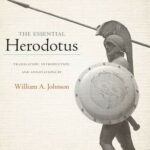
The Essential Herodotus
$24.99
| Title | Range | Discount |
|---|---|---|
| Trade Discount | 5 + | 25% |
- Description
- Additional information
Description
Breathing new life into the writings of the West’s first historian, The Essential Herodotus combines balanced selections of his work with succinct commentary and notes. The first collection of its kind, this volume presents Herodotus’s well-known writings on politics and war alongside his
research on folk traditions, foreign cultures, and natural wonders. William A. Johnson’s clear and lively translations make the original texts accessible in all their richness. Ideal for novices and historians alike, The Essential Herodotus reminds a 21st-century audience why these texts have stood
the test of time.
PrefaceAbout the TranslatorIntroductionMapsCentral Persons in HerodotusThe Great Kings of Persia (The Achaemenids)Time LineTHE RESEARCHES OF HERODOTUS OF HALICARNASSUS BOOK 1 Prologue Proem: The Opening Sentence
The Snatchings of Women
Croesus and Tales of Lydia Croesus
Gyges and the Wife of Candaules
Early Kings of Lydia: Ardys, Sadyattes, Alyattes, & the War against Miletus
Periander at Corinth: Arion and the Dolphin
Croesus and Solon
Atys and Adrastus
Croesus Tests the Oracles
Croesus Seeks an Ally
Background: Athens
Background: Sparta
Croesus Attacks Cyrus
Cyrus Counterattacks: The Siege of Sardis
Croesus on the Pyre
Cyrus and Croesus
The Marvels and Customs of Lydia
Tales of Cyrus and the Rise of the Persians Cyrus the Great
Background: Deioces, and the Rise of the Medes
The Birth and Upbringing of Cyrus
The Punishment of Harpagus
How Cyrus Became King
Cyrus’s Last Campaign The Land of the Massagetae
Cyrus Attacks the Massagetae
The Marvels and Customs of the Massagetae
BOOK 2 Cambyses and Tales of Egypt Cambyses
Psammetichus and the Antiquity of Egypt
Physical Geography of Egypt
The Nile River
The Marvels and Customs of Egypt
The Kings of Egypt
BOOK 3 Cambyses Invades Egypt The Causes for the Invasion
Preparations for the Invasion
The Attack on Egypt
Cambyses and the Apis Bull
The Madness of Cambyses
Crisis and Constitutional Debate A False Smerdis Declares Himself King and Cambyses Dies
The Seven Overthrow the MagiThe Constitutional Debate
BOOK 4 Darius Invades Scythia Why Darius Attacked Scythia
Origins of the Scythians
The Marvels and Customs of Scythia
Darius Prepares to Invade
Darius Crosses the Ister
Physical Geography of Scythia and Its Neighbors
Excursus: Sauromatae and the Amazons
The Neighboring States Take Counsel
The Scythians Lead and the Persians Follow
Darius Challenges the Scythians to Fight
Darius Retreats and the Scythians Give Chase
The Ionians at the Bridge and Darius’s Arrival
BOOKS 5 AND 6 The Ionian Revolt Aristagoras Visits Sparta
Athens and the Burning of Sardis
Histiaeus Hoodwinks Darius
The Persians Move to Reestablish Control Even as the Revolt Spreads
Histiaeus Joins the Revolt
Sea Battle at Lade and the Fall of Miletus
The Fate of Histiaeus
The Final Subjugation of Ionia
BOOK 6 The First Invasion of Greece: Mardonius and Marathon The Invasion of Europe: Mardonius’s Misadventure
Subjugation of the Cyclades
Subjugation of Eretria
The Battle of Marathon
BOOK 7 Xerxes Invades Greece Darius Decides upon a Full-Scale Invasion
Council of the Persians
Xerxes and the Dream
Xerxes Prepares to Invade
Bridging the Hellespont
Xerxes Marches into Europe
Xerxes Counts and Reviews the Host
Xerxes and Demaratus
Artemisium and Thermopylae Council at the Isthmus
Artemisium
Thermopylae
The Greek forcesXerxes and DemaratusBOOK 8 Salamis The Greeks Evacuate Athens
The Greek Fleet
The Persians Occupy Attica and Burn Athens
The Greeks Deliberate. Themistocles Tries to Persuade Eurybiades
Signs from the Gods
The Persians Deliberate. Artemisia Tries to Persuade Xerxes
The Greek Resolve Wavers. Themistocles’ Message to Xerxes
The Battle of Salamis
Xerxes Decides to Return to Susa
BOOK 9 Coda BibliographyNote on the SelectionsNote on the TextAcknowledgmentsPhoto CreditsPronouncing Glossary/Index
“Abridged editions…are intended for use in the classroom, so the target audience is teachers who would rather not bother culling passages from lengthier texts. Convenience, therefore, is a real selling factor, even if the editorial decisions are sometimes questionable-even frustrating…Johnson’s
edition has clear advantages (though it is slightly more expensive). For one thing, it includes a larger selection from Herodotus than the Shirley/Romm edition. In addition, unlike Shirley/Romm, Johnson supplements the text with a number of pedagogically useful figures, tables, and maps. Johnson’s
translation is clear and engaging, and his footnotes…supplement well Herodotus’s historical narrative. All in all, The Essential Herodotus is a very nice edition of the Histories. It will appeal mainly to classicists and humanities instructors seeking a compact, translated edition of Herodotus for
classroom use.” –F. A. Grabowski, CHOICE“This well-judged selection and charming translation splendidly brings out the variety and delights of Herodotus’s text. It embraces not only the famous battle accounts (Marathon, Salamis) but also the less familiar, equally captivating ethnographic narratives, from the marvels of Lydia to the
romantic liaisons of Amazons and Sauromatae and the Scythians’ cannabis use. Helpful subtitles and introductions to each section will prove invaluable to the general reader who is encountering Herodotus for the first time.”–Emily Baragwanath, University of North Carolina“The Essential Herodotus allows the reader to travel the ancient world with a Greek storyteller, investigator, and historian, whose range of interests was all encompassing, and who was a keen observer of the human condition in its physical and cultural environment. Johnson’s sensitive comments
justify his selections from Herodotus’s history and show its unity of themes and literary richness.”–Joseph Roisman, Colby College“The selections reflect the wide-ranging nature of Herodotus’s inquiries; the notes are concise, on-point, and informative, especially regarding major themes and historical method; and the lively and engaging translation retains the archaic storytelling features, the conversational tone, and the
narrative brilliance of the original. This book will be extremely useful for anyone who teaches ancient Greek history or culture courses.”–Christoper A. Baron, University of Notre Dame“Professor Johnson succeeds in presenting the full range of Herodotus’s interests (not just history as we know it, but history juxtaposed with and informed by ethnography, geography, primeval legend, and contemporary scientific debate) in a translation that is accurate, clear, and
engaging.”–Charles C. Chiasson, University of Texas at Arlington“William A. Johnson’s The Essential Herodotus is a pleasurable and honest alternative for anyone not at leisure to read the massive original. It exposes the reader to the same marvellous variety of materials while remaining completely faithful to the historian’s overarching concern, the
Greco-Persian War and its causes. Thus, the reader experiences all the domains of Herodotus’s research: foreign customs, folk traditions, storytelling, natural wonders and human marvels, divine forces obscurely present in human affairs, reflections on historical method, and of course wartime deeds
both glorious and terrible. And Johnson’s translation preserves all the charm of the Greek–its elegance, its frequent conversational tone, and its sly na?vet?.”–James Andrews, Ohio University“Johnson has chosen his selections from the Histories very well; readers will gain from these selections an excellent impression of the content and nature of Herodotus’s work as a whole. The comments that Johnson offers on Herodotean motifs, themes, and recurring patterns, moreover, are
outstanding–some of the best such comments I have ever read in a translation of the Histories. Armed with a knowledge of such patterns, readers should be well-quipped to appreciate Herodotus’ achievement as a historian, thinker, and literary artist.”–David Branscome, Florida State University
William A. Johnson, Professor of Classical Studies at Duke University, works broadly in the cultural history of Greece and Rome. His books include Readers and Reading Culture in the High Roman Empire: A Study of Elite Reading Communities (OUP, 2010), Ancient Literacies (OUP, 2009), and Bookrolls andScribes in Oxyrhynchus (2004).
Additional information
| Dimensions | 1 × 9 × 6 in |
|---|