

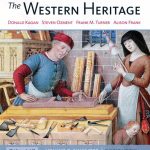
Western Heritage, The
$219.99
| Title | Range | Discount |
|---|---|---|
| Trade Discount | 5 + | 25% |
- Description
- Additional information
Description
EXPLORE THE CHANGING NATURE OF THE WEST
-
“What is the West?”—The text begins with an essay to engage students in the task of defining the West and to introduce them to the notion of cultural encounters.
-
“Encounters and Transformations”—These features, which appear in half the chapters, illustrate the main theme of the book by identifying specific encounters and showing how they led to significant transformations in the cultures of the West.
PERSONALIZE LEARNING WITH MYHISTORYLAB
- MyHistoryLab – MyHistoryLab is an online homework, tutorial, and assessment program that truly engages students in learning. It helps students better prepare for class, quizzes, and exams—resulting in better performance in the course. It provides educators a dynamic set of tools for gauging individual and class performance. And, MyHistoryLab comes from Pearson—your partner in providing the best digital learning experiences.
- Customizable – MyHistoryLab is customizable. Instructors choose what students’ course looks like. Homework, applications, and more can easily be turned off and off.
- Blackboard Single Sign-on – MyHistoryLab can be used by itself or linked to any course management system. Blackboard single sign-on provides deep linking to all New MyHistoryLab resources.
- Pearson eText and Chapter Audio – Like the printed text, students can highlight relevant passages and add notes. The Pearson eText can be accessed through laptops, iPads, and tablets. Download the free Pearson eText app to use on tablets. Students can also listen to their text with the Audio eText.
- Assignment Calendar & Gradebook – A drag and drop assignment calendar makes assigning and completing work easy. The automatically graded assessment provides instant feedback and flows into the gradebook, which can be used in the MyLab or exported.
- Personalized Study Plan – Students’ personalized plans promote better critical thinking skills. The study plan organizes students’ study needs into sections, such as Remembering, Understanding, Applying, and Analyzing.
- MyHistoryLab Margin Icons – Margin icons guide students from their reading material to Closer Looks, MyHistoryLibrary, and writing assessment.
- Instructor’s eText – Instructors have easy access to videos, readings, and more all in one place within their instructor’s eText.
- Writing Assessment – MyLab writing assessments help students build their knowledge of important disciplinary concepts. The MyLab auto-grader provides feedback on both content and mechanics. An overall score feeds into the MyLab gradebook.
- Class Preparation Tool – All of the very best class presentation resources can be found in one convenient destination, so instructors can keep students engaged throughout every class.
- Flashcards – Students can study key terms and concepts with their own personal set of flashcards.
- BlackBoard Single Sign-On – Available with Blackboard Learn 9.1 Service Pack 6 or higher. Educators and students can link their Blackboard and Pearson accounts to enable single sign-on to MyHistoryLab from within their Blackboard course. The flexible grade transfer capabilities allow the educator to control exactly which MyHistoryLab grades should be transferred to the Blackboard Grade Center. Educators can also continue to use the powerful assignment and analytics tools in the MyHistoryLab gradebook.
- Closer Looks – Interactive walkthroughs offer an in-depth look at key maps, images, and key primary sources. Closer Looks help students uncover meaning of historically important materials and understand their context.
- MyHistoryLibrary – MyHistoryLibrary offers over 600 primary source readings. Readings can be browsed by Topic, Title, Chronology, Geography, Theme, Author, and Bookshelf. Primary sources can also be printed. Every primary source is accompanied by a head note (abstract) as well as assessment questions for assignability and gauging reading comprehension.
- History Bookshelf – History Bookshelf has the most commonly assigned history works like Thomas Paine’s Common Sense, Homer’s The Iliad, and Machiavelli’s The Prince. Students canread, download, or print up to 100 masterpieces.
- Writing Assessments – MyHistoryLab writing assessments help students build their knowledge of important psychological concepts. After viewing an Author Video Lecture, students answer the writing prompts. The MyHistoryLab auto-grader provides feedback on both content and mechanics. An overall score feeds into the MyHistoryLab gradebook. Available Fall 2012 for US History, Available Spring 2013 for Western Civilization and World History.
IMPROVE CRITICAL THINKING
-
“Justice in History”—Found in every chapter, this feature presents a historically significant trial or episode in which different notions of justice (or injustice) were debated and resolved. Each “Justice in History” feature includes two pedagogical aids. “For Discussion” helps students explore the historical significance of the episode just examined. “Taking it Further” provides the student with a few references that can be consulted in connection with a research project.
-
“Different Voices”—Each chapter contains a new feature consisting of two primary source documents that present different and often opposing views regarding a particular person, event, or development.
-
Key Terms and Glossary—Key terms for each chapter are listed at the end of each chapter, and all key terms are listed in alphabetical order, together with their definitions, in the Glossary at the end of the book.
-
Chapter Review and Questions for Discussion—The text offers five different sets of questions in each chapter.
-
“Chapter Questions”—After the introduction to each chapter, the main question that the chapter addresses appears before the chapter outline. Each of the major sections of the chapter begins with the main question that the section addresses. These section questions appear once again at the end of the chapter under the heading “Chapter Questions.”
-
“Making Connections”—At the end of each chapter a set of questions under the heading “Making Connections” asks the student to think about some of the more specific issues discussed in the chapter.
-
“Questions for Analysis”—An additional set of “Questions for Analysis” under the heading “MyHistoryLab Connections” at the end of each chapter asks questions regarding the five most important items in MyHistoryLab that the student has been asked to read in the chapter.
-
“For Discussion”—Each “Justice in History” and “Different Voices” feature is followed by a set of questions under the heading “For Discussion.”
-
The caption for each map includes a question related to the map for which the text of the chapter provides an answer.
ENGAGE STUDENTS
-
Maps and Illustrations—More than 300 images of fine art and photos tell the story of Western civilization and help students visualize the past.
SUPPORT INSTRUCTORS
-
The outstanding supplements package supports a wide range of instructional settings, including small discussion groups, large lecture halls, and online or Web-based courses.
-
Create a Custom Text – For enrollments of at least 25, create your own textbook by combining chapters from best-selling Pearson textbooks and/or reading selections in the sequence you want. To begin building your custom text, visit www.pearsoncustomlibrary.com. You may also work with a dedicated Pearson Custom editor to create your ideal text—publishing your own original content or mixing and matching Pearson content. Contact your Pearson Publisher’s Representative to get started.
Overall Changes
- “MyHistoryLab Connections”–A section at the end of each chapter, “MyHistoryLab Connections” asks questions regarding five items in MyHistoryLab that the authors have decided are the most likely to enhance student learning.
- Critical thinking questions–Questions have also been added to the captions of all the maps.
- Suggested Readings–The list of Suggested Readings has been revised and updated, and many of the terms in the Glossary have been edited to improve student comprehension.
Chapter-by-Chapter Changes
Chapter 3
-
Expands the discussion of Corinth and adds a new illustration linking its legendary wealth of that polis to its strategic geographical position.
Chapter 4
-
Refines the interpretation of Alexander the Great and directs the student to a Closer Look in MyHistoryLab that analyzes the famous mosaic of Alexander at the Battle of Issus.
Chapter 5
-
Uses new images from the Theater of Marcellus and the Parthenon to illustrate and clarify the differences between Greek and Roman architectural style.
Chapter 7
-
Refers students to several new documents about early Christianity in MyHistoryLab and a section examining the role of religion in the fall of the Roman Empire.
Chapter 8
-
Clarifies the causes for the growing alienation between western and eastern rite Christians.
-
Discusses why on the basis of the Qur’an Muslims might disagree about the proper attitude they should take toward Jews and Christians.
Chapter 9
-
Revises the discussion of the differences between the status of Germanic and Roman women providing a much more carefully nuanced picture.
-
Takes account of the tremendous variation among the Germanic tribes in the status of women and pays more attention to class differences among women.
-
The discussion of monastic life notes how monks did not just copy ancient texts but made their own significant intellectual contributions.
-
The chapter offers an enriched discussion of Viking culture and technology.
Chapter 10
-
Expands the discussion of the papal monarchy.
Chapter 11
-
Employs the latest DNA research to revise the discussion of the epidemiology of the Black Death. Rather than leaving the cause of the Black Death as an open question, the new evidence gives greater support for the thesis that the high mortality came from a form of bubonic plague.
-
The discussions of the Mongol Empire and the Silk Road have also been enriched, as has the account of medieval guilds.
Chapter 12
-
Expands the discussion of Lorenzo Valla as an example of humanist critical techniques.
-
The debt of the Italian Renaissance to Muslim science is clarified.
Chapter 13
-
Adds a section on Aztec religion and examines how the spread of New World silver altered the global economy not just in Europe but also in China.
Chapter 14
-
Expands both the explanation of the religious justification of violence and the ways the Jesuit missionaries contributed to a better European understanding of other cultures.
Chapter 15
-
Adds additional material on the limits of religious toleration in the period.
Chapter 16
-
Presents a more nuanced interpretation of the theory of absolutism and adds an excerpt from John Locke’s Second Treatise of Government to illustrate the radicalism of his political thought.
Chapter 17
-
Expands the definition of alchemy and gives it a more prominent place in the section on the causes of the Scientific Revolution.
-
The new illustration of dissection in 1632 is superior to the eighteenth-century image in the third edition.
Chapter 18
-
Adds new material on the activities of slave traders in Africa.
Chapter 19
-
Simplifies the Map of the Enlightenment to make the international character of the Republic of Letters clearer.
-
References to works by Voltaire, Mary Wollstonecraft, Cesare Beccaria, and Catherine the Great reveal the diversity of the contributions that the Enlightenment made to Western culture.
Chapter 20
-
Includes a new illustration that highlights the militancy of the sans-culottes and includes new material on the Republic of Virtue.
-
The Closer Look in MyHistoryLab on the execution of Louis XVI supplements the discussion of this event in the text and in the Justice in History feature.
Chapter 21
-
Includes new material on industrialization on the European Continent and an illustration of the Stockton and Darlington Railway.
-
It also refers the student to a new map of English Railways in MyHistoryLab.
Chapter 22
-
Clarifies the doctrine of liberalism and includes excerpts from John Stuart Mill and David Ricardo to support the description of this new ideology.
-
Inclusion of the Chartist People’s Petition of 1838 helps explain why Britain did not experience a revolution in 1848.
Chapter 23
-
Includes a new map of the United Kingdom in 1910.
-
The section titled “The Irish Identity Conflict” has been completely rewritten, incorporating new material.
-
The section on “Russia: Revolution and Reaction” has been revised to reflect the emphasis in scholarship on nationalist upheaval within Russian Empire and adds a discussion on tsarist policy of Russification.
Chapter 24
-
Strengthens and reorganizes the section titled “The Birth of Modernism.”
Chapter 25
-
Includes a new map on the Eastern Front that identifies the national regions of Poland, the Baltics, Ukraine, Caucasus, East Prussia, and Galicia.
-
Adds new sub-sections titled “A War of Movement” and “Germany and the East ” to reflectcurrent research on the Eastern Front and the German occupation of Russian territories.
-
Another new sub-section, “A Very Different Battle” deals with the influenza pandemic. The discussion of the October Revolution has also been expanded.
Chapter 26
-
Extensively reorganized to make discussions more coherent, to improve “teachability,” and to take into account recent research.
-
Adds new sub-sections titled “NEP and Nationalities ” and “From Lenin to Stalin.”
-
The substantially revised section on the Irish Revolution includes new material.
Chapter 27
-
Includes a new section titled “The Wars within the War’ that takes into account the most recent research on the Holocaust and the Eastern Front.
-
The section titled “The Decisive Front” has been extensively revised and includes new material.
Chapter 28
-
Incorporates new material in the section titled “Devastation, Death, and DPs.”
Chapter 29
-
Adds a new sub-section, “The Turn to Terrorism,” in the section on “Economic Stagnation and Political Change in the 1970s and 1980s.”
-
Extensively revises and adds new material to the sections “Islam and the West” and“The European Union.”
-
This chapter also brings the story of Russia under Putin up-to-date.
Found in this Section:
1. Brief Table of Contents
2. Full Table of Contents
1. BRIEF TABLE OF CONTENTS
Documents
Maps
Preface
About the Authors
What Is the Western Heritage?
INTRODUCTION: The West before 1300
PART 3: Europe in Transition, 1300–1750
Chapter 9: The Late Middle Ages: Social and Political Breakdown (1300–1453)
Chapter 10: Renaissance and Discovery
Chapter 11: The Age of Reformation
Chapter 12: The Age of Religious Wars
Chapter 13: European State -Consolidation in the Seventeenth and Eighteenth Centuries
Chapter 14: New Directions in Thought and Culture in the Sixteenth and Seventeenth Centuries
Chapter 15: Society and Economy Under the Old Regime in the Eighteenth Century
Chapter 16: The Transatlantic Economy, Trade Wars, and Colonial Rebellion
PART 4: Enlightenment and Revolution, 1700–1850
Chapter 17: The Age of Enlightenment: Eighteenth-Century Thought
Chapter 18: The French Revolution
Chapter 19: The Age of Napoleon and the Triumph of Romanticism
Chapter 20: The Conservative Order and the Challenges of Reform (1815–1832)
Chapter 21: Economic Advance and Social Unrest (1830–1850)
PART 5: Toward the Modern World, 1850–1939
Chapter 22: The Age of Nation-States
Chapter 23: The Building of European Supremacy: Society and Politics to World War I
Chapter 24: The Birth of Modern European Thought
Chapter 25: The Age of Western Imperialism
Chapter 26: Alliances, War, and a Troubled Peace
Chapter 27: The Interwar Years: The Challenge of Dictators and Depression
PART 6: Global Conflict, Cold War, and New Directions, 1939–2012
Chapter 28: World War II
Chapter 29: The Cold War Era, Decolonization, and the Emergence of a New Europe
Chapter 30: Social, Cultural, and Economic Challenges in the West through the Present
Glossary
Index
2. FULL TABLE OF CONTENTS
Documents
Maps
Preface
About the Authors
What Is the Western Heritage?
INTRODUCTION: The West before 1300
Early Humans and Their Culture
The Paleolithic Age
The Neolithic Age
Early Civilizations to about 1000 B.C.E.
Mesopotamian Civilization
Egyptian Civilization
Palestine and the Religion of the Israelites
The Greeks
The Polis
Greek Political Philosophy and the Crisis of the Polis
The Empire of Alexander the Great
Rome
The Republic and Expansion in the Mediterranean
From Republic to Empire
The Principate and the Empire
Christianity
Decline and Fall of the Roman Empire
Europe Enters the Middle Ages
The Byzantine Empire
The Rise of Islam
New Importance of the Christian Church
Charlemagne
Feudal and Manorial Society
Church and State in the High Middle Ages
The Division of Christendom
The Rise of Towns
The Crusades
The Rise of New Monarchies
Universities and Scholasticism
In Perspective
PART 3: Europe in Transition, 1300—1750
Chapter 9: The Late Middle Ages: Social and Political Breakdown (1300—1453)
The Black Death
Preconditions and Causes of the Plague
Popular Remedies
Social and Economic Consequences
New Conflicts and Opportunities
The Hundred Years’ War and the Rise of National Sentiment
The Causes of the War
Progress of the War
Ecclesiastical Breakdown and Revival: The Late Medieval Church
The Thirteenth-Century Papacy
Boniface VIII and Philip the Fair
The Avignon Papacy (1309—1377)
John Wycliffe and John Huss
The Great Schism (1378—1417) and the Conciliar Movement in the Church to 1449
Medieval Russia
Politics and Society
Mongol Rule (1243—1480)
In Perspective
Key Terms
Review Questions
Suggested Readings
MyHistoryLab Media Assignments
A BURIAL SCENE FROM THE BLACK DEATH
Dealing with Death
Who Runs the World: Priests or Princes?
Chapter 10: Renaissance and Discovery
The Renaissance in Italy (1375—1527)
The Italian City-States
Humanism
High Renaissance Art
Slavery in the Renaissance 3
Italy’s Political Decline: The French Invasions (1494—1527)
Charles VIII’s March Through Italy
Pope Alexander VI and the Borgia Family
Pope Julius II
Niccolò Machiavelli
Revival of Monarchy in Northern Europe
France
Spain
England
The Holy Roman Empire
The Northern Renaissance
The Printing Press
Erasmus
Humanism and Reform
Voyages of Discovery and the New Empires in the West and East
The Portuguese Chart the Course
The Spanish Voyages of Columbus
The Spanish Empire in the New World
The Church in Spanish America
The Economy of Exploitation
Mining
The Impact on Europe
In Perspective
Key Terms
Review Questions
Suggested Readings
MyHistoryLab Media Assignments
The Renaissance Garden
LEONARDO PLOTS THE PERFECT MAN
Is the “Renaissance Man” a Myth?
Chapter 11: The Age of Reformation
Society and Religion
Social and Political Conflict
Popular Religious Movements and Criticism of the Church
Martin Luther and the German Reformation to 1525
The Attack on Indulgences
Election of Charles V
Luther’s Excommunication and the Diet of Worms
Imperial Distractions: War with France and the Turks
How the Reformation Spread
The Peasants’ Revolt
The Reformation Elsewhere
Zwingli and the Swiss Reformation
Anabaptists and Radical Protestants
John Calvin and the Genevan Reformation
Political Consolidation of the Lutheran Reformation
The Diet of Augsburg
The Expansion of the Reformation
Reaction Against Protestants
The Peace of Augsburg
The English Reformation to 1553
The Preconditions of Reform
The King’s Affair
The “Reformation Parliament”
Wives of Henry VIII
The King’s Religious Conservatism
The Protestant Reformation under Edward VI
Catholic Reform and Counter-Reformation
Sources of Catholic Reform
Ignatius of Loyola and the Jesuits
The Council of Trent (1545—1563)
The Social Significance of the Reformation in Western Europe
The Revolution in Religious Practices and Institutions
The Reformation and Education
The Reformation and the Changing Role of Women
Family Life in Early Modern Europe
Later Marriages
Arranged Marriages
Family Size
Birth Control
Wet Nursing
Loving Families?
Literary Imagination in Transition
Miguel de Cervantes Saavedra: Rejection of Idealism
William Shakespeare: Dramatist of the Age
In Perspective
Key Terms
Review Questions
Suggested Readings
MyHistoryLab Media Assignments
A SAINT AT PEACE IN THE GRASP OF TEMPTATION
A Raw Deal for the Common Man, or Just Desserts?
Table Manners
Chapter 12: The Age of Religious Wars
Renewed Religious Struggle
The French Wars of Religion (1562—1598)
Appeal of Calvinism
Catherine de Médicis and the Guises
The Rise to Power of Henry of Navarre
The Edict of Nantes
Imperial Spain and Philip II (r. 1556—1598)
Pillars of Spanish Power
The Revolt in the Netherlands
England and Spain (1553—1603)
Mary I (r. 1553—1558)
Elizabeth I (r. 1558—1603)
The Thirty Years’ War (1618—1648)
Preconditions for War
Four Periods of War
The Treaty of Westphalia
In Perspective
Key Terms
Review Questions
Suggested Readings
MyHistoryLab Media Assignments
BAROQUE AND PLAIN CHURCH: ARCHITECTURAL REFLECTIONS OF BELIEF
The Great Debate Over Religious Tolerance
Going to the Thea
Chapter 13: European State -Consolidation in the Seventeenth and Eighteenth Centuries
The Netherlands: Golden Age to Decline
Urban Prosperity
Economic Decline
Two Models of European Political Development
Constitutional Crisis and Settlement in Stuart England
James I
Charles I
The Long Parliament and Civil War
Oliver Cromwell and the Puritan Republic
Charles II and the Restoration of the Monarchy
The “Glorious Revolution”
The Age of Walpole
Rise of Absolute Monarchy in France: The World of Louis XIV
Years of Personal Rule
Versailles
King by Divine Right
Louis’s Early Wars
Louis’s Repressive Religious Policies
Louis’s Later Wars
France After Louis XIV
Central and Eastern Europe
Poland: Absence of Strong Central Authority
The Habsburg Empire and the Pragmatic Sanction
Prussia and the Hohenzollerns
Russia Enters the European Political Arena
The Romanov Dynasty
Peter the Great
Russian Expansion in the Baltic: The Great Northern War
In Perspective
Key Terms
Review Questions
Suggested Readings
MyHistoryLab Media Assignments
Early Controversy Over Tobacco and Smoking
VERSAILLES
The Debate over the Origin and Character of Political Authority
Chapter 14: New Directions in Thought and Culture in the Sixteenth and Seventeenth Centuries
The Scientific Revolution
Nicolaus Copernicus Rejects an Earth-Centered Universe
Tycho Brahe and Johannes Kepler Make New Scientific Observations
Galileo Galilei Argues for a Universe of Mathematical Laws
Isaac Newton Discovers the Laws of Gravitation
Philosophy Responds to Changing Science
Nature as Mechanism
Francis Bacon: The Empirical Method
René Descartes: The Method of Rational Deduction
Thomas Hobbes: Apologist for Absolute Government
John Locke: Defender of Moderate Liberty and Toleration
The New Institutions of Expanding Natural Knowledge
Women in the World of the Scientific Revolution
The New Science and Religious Faith
The Case of Galileo
Blaise Pascal: Reason and Faith
The English Approach to Science and Religion
Continuing Superstition
Witch Hunts and Panic
Village Origins
Influence of the Clergy
Who Were the Witches?
End of the Witch Hunts
Baroque Art
In Perspective
Key Terms
Review Questions
Suggested Readings
MyHistoryLab Media Assignments
THE SCIENCES AND THE ARTS
Descartes and Swift Debate the Scientific Enterprise
Midwives
Chapter 15: Society and Economy Under the Old Regime in the Eighteenth Century
Major Features of Life in the Old Regime
Maintenance of Tradition
Hierarchy and Privilege
The Aristocracy
Varieties of Aristocratic Privilege
Aristocratic Resurgence
The Land and Its Tillers
Peasants and Serfs
Aristocratic Domination of the Countryside: The English Game Laws
Family Structures and the Family Economy
Households
The Family Economy
Women and the Family Economy
Children and the World of the Family Economy
The Revolution in Agriculture
New Crops and New Methods
Expansion of the Population
The Industrial Revolution of the Eighteenth
Century
A Revolution in Consumption
Industrial Leadership of Great Britain
New Methods of Textile Production
The Steam Engine
Iron Production
The Impact of the Agricultural and Industrial Revolutions on Working Women
The Growth of Cities
Patterns of Preindustrial Urbanization
Urban Classes
The Urban Riot
The Jewish Population: The Age of the Ghetto
In Perspective
Key Terms
Review Questions
Suggested Readings
MyHistoryLab Media Assignments
AN ARISTOCRATIC COUPLE
Two Eighteenth-Century Writers Contemplate the Effects of Different Economic Structures
Water, Washing, and Bathing
Chapter 16: The Transatlantic Economy, Trade Wars, and Colonial Rebellion
Periods of European Overseas Empires
Mercantile Empires
Mercantilist Goals
French–British Rivalry
The Spanish Colonial System
Colonial Government
Trade Regulation
Colonial Reform under the Spanish Bourbon Monarchs
Black African Slavery, the Plantation System, and the Atlantic Economy
The African Presence in the Americas
Slavery and the Transatlantic Economy
The Experience of Slavery
Mid-Eighteenth-Century Wars
The War of Jenkins’s Ear
The War of the Austrian Succession (1740–1748)
The “Diplomatic Revolution” of 1756
The Seven Years’ War (1756–1763)
The American Revolution and Europe
Resistance to the Imperial Search for Revenue
The Crisis and Independence
American Political Ideas
Events in Great Britain
Broader Impact of the American Revolution
In Perspective
Key Terms
Review Questions
Suggested Readings
MyHistoryLab Media Assignments
Sugar Enters the Western Diet
A SUGAR PLANTATION IN THE WEST INDIES
The Atlantic Passage
The Columbian Exchange: Disease, Animals, and Agriculture
PART 4: Enlightenment and Revolution, 1700–1850
Chapter 17: The Age of Enlightenment: Eighteenth-Century Thought
Formative Influences on the Enlightenment
The Emergence of a Print Culture
The Philosophes
Philosophes and Patrons
The Enlightenment and Religion
Deism
Toleration
Radical Enlightenment Criticism of Christianity
The Limits of Toleration
The Jewish Enlightenment
The Enlightenment and Society
The Encyclopedia: Freedom and Economic Improvement
Beccaria and Reform of Criminal Law
The Physiocrats and Economic Freedom
Adam Smith on Economic Growth and Social Progress
Political Thought of the Philosophes
Montesquieu and Spirit of the Laws
Rousseau: A Radical Critique of Modern Society
Enlightened Critics of European Empires
Women in the Thought and Practice of the Enlightenment
Rococo and Neoclassical Styles in Eighteenth-Century Art
Enlightened Absolutism
Frederick the Great of Prussia
Joseph II of Austria
Catherine the Great of Russia
The Partitions of Poland
The End of the Eighteenth Century in Central and Eastern Europe
In Perspective
Key Terms
Review Questions
Suggested Readings
MyHistoryLab Media Assignments
Coffeehouses and Enlightenment
AN EIGHTEENTH-CENTURY ARTIST APPEALS TO THE ANCIENT WORLD
Maria Theresa and Joseph II of Austria Debate Toleration
Explore the changing nature of the West
Rather than looking at Western civilization only as the history of Europe from ancient times to the present, this groundbreaking book examines the changing nature of the West—how the definition of the West has evolved and has been transformed throughout history. It explores the ways Western civilization has changed as a result of cultural encounters with different beliefs, ideas, technologies, and peoples, both outside the West and within it. Presenting a balanced treatment of political, social, religious, and cultural history, this text emphasizes the ever-shifting boundaries of the geographic and cultural realm of the West.
MyHistoryLab is an integral part of the Levack program. Key learning applications include Closer Looks, MyHistoryLibrary, and writing assessment.
A better teaching and learning experience
This program will provide a better teaching and learning experience—for you and your students. Here’s how:
- Personalize Learning– MyHistoryLab is online learning. MyHistoryLab engages students through personalized learning and helps instructors from course preparation to delivery and assessment.
- Improve Critical Thinking–Critical thinking questions throughout the text help students focus on what they need to learn.
- Engage Students–Fine art and photos engage students in the material.
- Support Instructors– A full set of supplements, including MyHistoryLab, provides instructors with all the resources and support they need.
Note: MyHistoryLab does not come automatically packaged with this text.
Explore the changing nature of the West
Rather than looking at Western civilization only as the history of Europe from ancient times to the present, this groundbreaking book examines the changing nature of the West—how the definition of the West has evolved and has been transformed throughout history. It explores the ways Western civilization has changed as a result of cultural encounters with different beliefs, ideas, technologies, and peoples, both outside the West and within it. Presenting a balanced treatment of political, social, religious, and cultural history, this text emphasizes the ever-shifting boundaries of the geographic and cultural realm of the West.
MyHistoryLab is an integral part of the Levack program. Key learning applications include Closer Looks, MyHistoryLibrary, and writing assessment.
A better teaching and learning experience
This program will provide a better teaching and learning experience—for you and your students. Here’s how:
-
Personalize Learning– MyHistoryLab is online learning. MyHistoryLab engages students through personalized learning and helps instructors from course preparation to delivery and assessment.
-
Improve Critical Thinking–Critical thinking questions throughout the text help students focus on what they need to learn.
-
Engage Students–Fine art and photos engage students in the material.
-
Support Instructors– A full set of supplements, including MyHistoryLab, provides instructors with all the resources and support they need.
Additional information
| Dimensions | 2.20 × 8.50 × 11.00 in |
|---|---|
| Imprint | |
| Format | |
| ISBN-13 | |
| ISBN-10 | |
| Author | Donald M. Kagan, Steven Ozment, Frank M. Turner, Alison Frank |
| Subjects | history, higher education, humanities, western civilization, Humanities and Social Sciences |